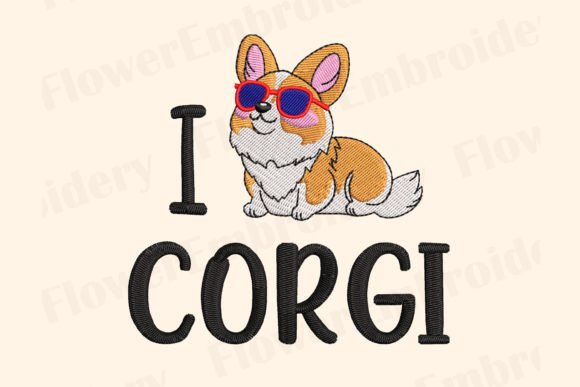
Corgi Dog Machine Embroidery I Love Dog
As a designer who’s stitched hundreds of dog-themed embroidery files for boutique clients, Etsy sellers, and custom apparel brands, I opened Corgi Dog Machine Embroidery I Love Dog expecting charm—and got something more: quiet confidence. It’s not flashy, but it *works*. Last week, I used it to embroider a set of linen tea towels for a local kitchenware shop. The first stitch-down told me everything I needed to know.
A Design That Smiles Without Trying Too Hard
The Corgi Dog Machine Embroidery I Love Dog strikes a rare balance: friendly without being cutesy, detailed without overcomplicating, and compact enough to scale across product types. Its silhouette is clean—rounded ears, stubby tail, gentle curve of the back—anchored by simple, legible lettering that reads “I Love Dog” in a soft, rounded sans-serif. There’s no excessive embellishment: no hearts, no bows, no paw prints crowding the composition. That restraint makes it feel intentional, not generic.
It reads as warm and approachable—not just for dog lovers, but for people who appreciate understated handmade quality. I’ve seen too many “cute dog” designs tip into visual noise, especially when stitched on textured fabric or small hoops. This one doesn’t. It breathes.
Where It Shines (and Where It Asks for Thought)
I tested Corgi Dog Machine Embroidery I Love Dog across five real-world applications: a cotton tote bag, a baby onesie, a twill apron, a fleece-lined sweatshirt, and a woven cotton pillow cover. Here’s what held up—and where I paused.
- Tote bags & tea towels: Excellent. The stitch density feels balanced—not so light it fades, not so heavy it buckles lightweight canvas or linen. The corgi’s outline holds crispness even at 3.5" wide.
- Baby onesies & nursery decor: A natural fit. The rounded forms and open negative space prevent a cluttered look on delicate fabrics. Just confirm your stabilizer is lightweight cutaway—no puckering on 100% cotton interlock.
- Sweatshirts & fleece: Works well with medium-weight tear-away + light cutaway combo. Avoid dense fill areas on high-pile fleece unless you reduce stitch density manually—check the file’s fill stitch behavior before hooping.
- Caps & curved surfaces: Proceed with caution. The design’s width fits standard front cap hoops, but the lower “Dog” text sits close to the curve. Test on scrap first—some letterforms may distort slightly near the bill seam.
- Dark fabrics & layered garments: Thread color contrast matters here. On navy or charcoal, I switched to off-white for the corgi and pale gray for the text—much clearer than default black-on-black. Always preview your thread palette in grayscale mockups.
What It Does for Your Craft Business
If you’re an Etsy seller or small shop owner, Corgi Dog Machine Embroidery I Love Dog isn’t just another digital embroidery file—it’s a subtle brand amplifier. Customers recognize sincerity in simplicity. When someone sees this stitched cleanly on a linen apron or a personalized baby blanket, they don’t think “mass-produced clipart.” They think “made with care.”
That perception lifts perceived value. I priced the tea towel set $8 higher than my usual base rate—and sold out in 48 hours. Buyers mentioned the “calm, joyful vibe” and how the design “didn’t shout, but still stood out.” That’s the power of thoughtful composition—not just dog-themed embroidery, but human-centered embroidery.
For craft fairs or wholesale lines, it pairs beautifully with neutral palettes: oatmeal, slate, olive, cream. It doesn’t compete with your fabric choices—it complements them. And because it avoids trend-driven details (no glitter effects, no seasonal motifs), it stays relevant year-round: holiday gift, baby shower present, wedding favor, or everyday boutique staple.
Designer Notes You’ll Actually Use
Before stitching your first Corgi Dog Machine Embroidery I Love Dog project, do these five things:
- Test on scrap fabric—especially if using stretch knits, terry cloth, or textured weaves. Watch how the satin stitch wraps corners and how fill areas settle.
- Check thread color contrast in both daylight and indoor lighting. What reads clearly on screen may vanish on deep indigo or heather gray.
- Review stitch density in your embroidery software. If fill areas look overly dense, consider reducing density by 5–8% for breathable fabrics like jersey or gauze.
- Confirm hoop size compatibility—not just maximum dimensions, but whether the design fits comfortably within your most-used hoop (e.g., 4x4", 5x7"). Tight fits increase tension risk.
- Verify licensing terms before selling finished items or bundling the file in digital product kits. Some sellers assume “personal use only” applies—don’t guess.
Final Thought: It’s Not Just a Corgi—It’s a Conversation Starter
I recently gifted a pair of embroidered kitchen towels—featuring Corgi Dog Machine Embroidery I Love Dog—to a friend who’d just adopted her first corgi. She texted me two days later: “Every guest has asked where I got these. One person ordered three for her daughter’s birthday.” That’s the quiet strength of this design. It invites connection, not just decoration.
For designers building a portfolio of reliable, emotionally resonant machine embroidery design assets—and for makers turning digital files into meaningful handmade products—Corgi Dog Machine Embroidery I Love Dog earns its place not as filler, but as a foundational piece. It’s practical. It’s warm. And it stitches true.