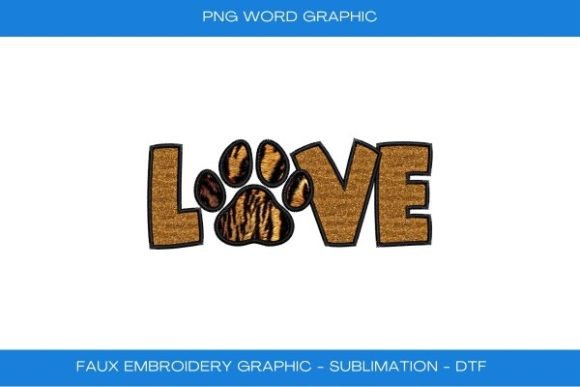
Love Paw Faux Embroidery Review
A Designer’s First Impression: Friendly, Clean, and Brand-Ready
As an embroidery designer who’s digitized over 2,000 small business logos—from artisanal bakeries to rescue-centered pet brands—I opened Love Paw Faux Embroidery expecting charm. What I found was more: a balanced, confident visual that reads instantly as both warm and professional. The “faux embroidery” treatment—realistic black stitching on a clean background—gives the impression of hand-finished quality without the production overhead. It doesn’t scream “crafty clutter” or lean too far into minimalist sterility. Instead, it lands in that sweet spot small businesses need: approachable yet polished, playful but purpose-built.
Where Love Paw Faux Embroidery Shines in Real Business Use
This design isn’t just decorative—it’s functional branding infrastructure. Here’s where it delivers tangible value:
- Embroidered patches: At its native 10 × 3.9 inch scale (300 DPI), Love Paw Faux Embroidery scales beautifully down to 2.5–3 inch sew-on patches for jackets, tote bags, or staff aprons—retaining clarity in the paw outline and letter spacing.
- Staff uniforms & aprons: As a chest logo on cotton-poly blends or denim, it reads cleanly at 3.5 inches wide. Its horizontal orientation works naturally above pockets or along waistbands—no awkward cropping needed.
- Cap embroidery: When resized thoughtfully (ideally 2.25–2.75 inches wide), it holds up well on structured front panels—especially on light or mid-tone caps where black thread contrast remains strong.
- Tote bag design & product packaging: Sublimation-ready and crisp at 300 DPI, Love Paw Faux Embroidery transfers cleanly onto polyester-blend totes, kraft paper tags, or reusable gift wraps—adding handmade credibility to retail-ready items.
- Etsy branding & boutique merchandise: For makers selling handmade products, this graphic bridges digital and tactile perception. Used in printable mockups or on woven labels, it signals care and consistency—key trust signals for online shoppers scanning quickly.
Use With Care: Design Limits Every Small Business Should Know
No design is universal—and Love Paw Faux Embroidery has boundaries worth honoring before production:
- Avoid sub-2-inch applications on curved surfaces—like rounded cap fronts or tapered sleeves—where fine line integrity may blur during hooping or stitching.
- Don’t rely on it for dark uniforms without testing thread color contrast. While the PNG shows black stitching, actual machine embroidery requires matching thread to fabric tone. On charcoal or navy, a matte black thread may recede; consider charcoal-gray or deep navy thread instead.
- Texture matters. On heavy canvas, terry cloth, or bouclé knits, stitch density and underlay must be adjusted—Love Paw Faux Embroidery’s clean lines assume a smooth-to-medium fabric texture. Always test on your exact substrate.
- Frequent washing demands reinforcement. If used on staff aprons or café server shirts, pair it with tear-away + cut-away stabilizer combo and slightly reduced stitch density to prevent puckering over time.
How This Graphic Strengthens Your Brand Identity
For small businesses, every branded touchpoint shapes perception—and Love Paw Faux Embroidery quietly elevates yours. Its consistent proportions, balanced negative space, and intentional “stitched” aesthetic reinforce authenticity. Customers don’t just see a logo; they register craft, attention, and intention. That translates directly to trust—especially for handmade brands, local boutiques, and pet-focused businesses where emotional resonance drives loyalty.
Used across multiple assets—apron embroidery, cap embroidery, tote bag design, and even printed product labels—it builds visual consistency without repetition fatigue. Unlike overly complex logos, Love Paw Faux Embroidery works equally well solo (as a sleeve accent) or paired with a wordmark (on a shop banner or receipt stamp). That flexibility makes it a smart long-term design asset—not just a one-off graphic.
Practical Notes from the Embroidery Studio Floor
Before you digitize, order patches, or press “print” on your next batch of custom apparel, here’s what I do—and recommend you do—with Love Paw Faux Embroidery:
- Test in black and white first. Convert the PNG to grayscale to assess tonal balance—this reveals hidden contrast issues before digitizing.
- Check patch-size viability. Resize it to 2.25 inches wide and print at 100%—hold it against real fabric swatches. Does the paw detail hold? Is the “Love” lettering legible?
- Review thread color pairing. Even though it’s a faux-embroidery PNG, your final stitched version needs real thread choices. Print a color swatch sheet alongside your brand palette.
- Inspect spacing and kerning. Especially between “Love” and “Paw”—tight spacing can collapse when stitched. Adjust manually if digitizing for machine embroidery.
- Confirm hoop size compatibility. Horizontal designs like this often require larger hoops (e.g., 5×7 or 6×10). Measure your machine’s max embroidery area before committing to production.
- Always test on real fabric. Run a sample on your exact garment or patch material—not just printer paper. Fabric stretch, weave, and coating change how edges render.
- Create a client-facing mockup. Use Love Paw Faux Embroidery in a realistic printable mockup (tote, cap, apron) to secure approval before cutting thread or ordering blanks.
- Compare beside other design assets. Drop it into your brand board next to your logo, fonts, and color palette. Does it harmonize—or compete?
- Verify commercial licensing. Since this is listed as a Graphics product in the Crafts category, confirm usage rights cover resale, sublimation, and embroidered patch production before scaling.
Final Thought: A Strategic Asset, Not Just a Pretty Graphic
Love Paw Faux Embroidery isn’t just another digital embroidery file—it’s a versatile, brand-aligned tool built for growth. Whether you’re launching your first Etsy shop, outfitting a neighborhood café team, or expanding your pet brand’s merch line, this design supports professionalism without sacrificing warmth. Used intentionally—with attention to scale, fabric, and context—it becomes part of your brand’s quiet authority. And in small business, that kind of consistency? That’s what turns first-time buyers into regulars.