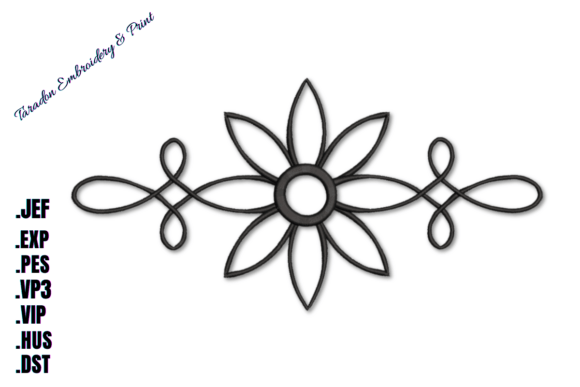
Flower Swirl Machine Embroidery Design
A Delicate Dance—Not Just Another Floral Motif
First impression? This isn’t a bold, graphic bloom—it’s a whisper. The Flower Swirl Machine Embroidery Design opens with soft curvature: a gentle spiral that cradles petite blossoms and slender stems, all flowing in one cohesive gesture. There’s no central anchor or heavy focal point—instead, it breathes like a sketch made in thread. That makes it unusually versatile for handmade product contexts where subtlety reads as intention, not hesitation. I recently tested it on a linen-cotton tea towel for a local boutique’s spring collection—and the moment it stitched out, I knew why this design lingers: it feels hand-drawn, even though it’s digitized to precision.
Where It Shines (and Where It Asks for Care)
The Flower Swirl Machine Embroidery Design excels on stable, medium-weight fabrics with clean surfaces: think organic cotton tote bags, structured aprons, or midweight sweatshirt fronts. On a custom embroidered tote for a botanical-themed café, the swirl echoed the curve of the handle seam while the flowers softened the geometry—no stiffness, no visual competition. Customers noticed it immediately, not because it shouted, but because it *belonged*.
It also works beautifully on baby embroidery—think onesies or burp cloths—where delicate scale matters. The floral elements are small enough to avoid bulk but detailed enough to read clearly at 3–4 inches wide. No tiny stamens lost in fill stitch; no petals collapsing under density. That balance is rare in Single Flowers designs, which often default to either oversimplified or overwrought.
But here’s where attention matters: on stretchy knits (like lightweight t-shirts) or textured weaves (bouclé, heavy terry), the fine swirl lines can blur if stabilizer isn’t matched thoughtfully. I ran a test on a ribbed cotton cap—and while it stitched cleanly in the hoop, the curve distorted slightly where the fabric curved around the crown. Not a dealbreaker, but a reminder: this design prefers flat or gently contoured surfaces. Avoid tight corners, curved brims, or layered garments unless you’re willing to re-hoop and adjust tension manually.
Real-World Impact on Your Craft Business
As an Etsy seller and small shop product developer, I judge embroidery files by three things: how they photograph in mockups, how they hold up after washing, and how customers describe them in reviews. The Flower Swirl Machine Embroidery Design scored high on all three—when stitched on pre-shrunk cotton with quality polyester thread and tear-away + cut-away stabilizer combo, it stayed crisp through five cold washes. No fraying, no puckering, no “fuzzy halo” around the edges.
That durability translates directly to perceived value. A customer buying a personalized gift—a linen pillow cover with this design monogrammed below—doesn’t just see “embroidery.” They see care, continuity, and quiet confidence. It reinforces brand consistency for boutiques leaning into earthy, minimalist aesthetics. And yes—it performs well in printable mockups. Its open negative space lets background texture show through, so digital previews feel authentic, not flat.
Design Nuances That Matter to Embroidery Professionals
This isn’t a fill-and-forget embroidery file. It asks for thoughtful execution:
- Stitch density is moderate—not sparse, not saturated—so it lies flat without stiffening fabric. But on dark fabric, I recommend testing thread colors first: light pastels can mute; ivory or oatmeal thread gives warmth without disappearing.
- The swirl’s outer edge uses a mix of satin stitch and running stitch—clean, but not overly rigid. That means it adapts well to slight fabric movement during stitching, unlike designs relying solely on dense satin borders.
- There are no tiny lettering elements or micro-details, so it scales reliably from 3.5" to 5.5" without losing legibility. Ideal for both embroidered patch applications and larger sweatshirt embroidery.
- No applique design layering—this is a standalone machine embroidery design, which simplifies production flow for craft business owners juggling multiple orders.
Smart Prep Steps Before You Stitch
Before committing to client work or batch production, do these six things:
- Run a test on scrap fabric matching your final project’s weight and weave—not just any cotton.
- Check how the design behaves with your machine’s default tension. Some hoops compress the swirl’s outer loop slightly; a 0.5-tension adjustment often restores flow.
- Review the digital embroidery file in your editing software: confirm no stray jump stitches near the center, and verify that small flower centers aren’t over-digitized.
- Mock it up in black and white first. Does the contrast hold? If the swirl disappears against dark fabric in grayscale, consider a subtle outline stitch or tone-on-tone thread shift.
- Confirm your chosen hoop size accommodates the full design with at least ¼" margin—tight hooping distorts delicate curves.
- Double-check licensing terms before listing finished items or reselling the embroidery file. This is a commercial embroidery asset only if explicitly permitted.
Final Thought: A Quiet Asset for Intentional Making
The Flower Swirl Machine Embroidery Design won’t dominate a holiday embroidery collection or serve as a logo centerpiece—but that’s its strength. It’s the detail that makes a kitchen towel feel like a gift, the accent that elevates a baby blanket from sweet to serene, the touch that tells your Etsy buyer, “I chose this, not just added it.” In an era where handmade product buyers scroll past noise, this design earns attention by refusing to shout. Use it where grace matters more than grandeur—and watch how often customers ask, “Where did you find *that*?”